


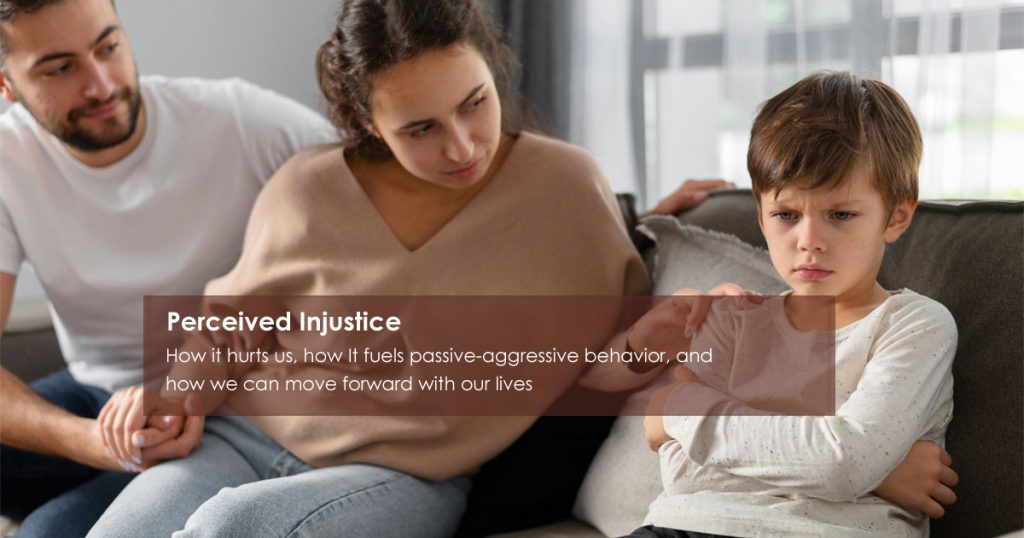
How It Hurts Us, How It Fuels Passive-Aggressive Behavior, and How We Can Move Forward with Our Lives
The sense of injustice is one of the most intense and destructive human experiences. It does not concern only what objectively happened, but mainly how we interpret it: who received more, who was acknowledged, who was supported, who was “wronged.” Especially within the family, perceived injustice is not experienced merely as dissatisfaction, but as a deep wound that touches on worth, love, and the sense of belonging.
According to Rational-Emotive & Cognitive Behavior Therapy (RECBT), what hurts us is not the unequal treatment itself, but the absolute beliefs that are activated around it:
“It is not fair and it should not have happened,”
“Since they treat me this way, it means they do not value me,”
“If the injustice is not corrected, I cannot be well.”
When these thoughts/beliefs remain unquestioned, the feeling of hurt becomes chronic and often turns into anger, bitterness, or passive-aggressive behavior.
Perceived Injustice from Parents
A common example concerns the belief that parents favored one child at the expense of another. This may involve greater financial support, more tolerance, or more emotional presence. The event (A) may be real or partially real. However, the intensity of the pain (C) arises from the belief (B):
“My parents must be absolutely fair, and if they are not, this is unbearable and proves that I am worth less.”
This thought often leads to emotional withdrawal, coldness, or silent punishment. The individual does not openly express the hurt, but “holds on to it,” hoping that others will understand or correct the injustice on their own. In practice, however, the wound deepens and the relationship deteriorates.
Perceived Injustice Between Siblings
In sibling relationships, injustice is often experienced as longstanding: “She always had more,” “I always had to tolerate/endure.” When a person feels that they carry more responsibilities or that their effort is not acknowledged, the thought “This is not fair and I should not have to tolerate it” intensifies anger and frustration. Instead of direct communication, indirect reactions appear: delays, avoidance, irony, or emotional “freezing.” Thus, the injustice is not resolved, but becomes a core element of identity and of the relationship.
The RECBT Approach to Injustice
RECBT does not argue that injustice does not exist, nor that we should accept it passively. What it proposes is to separate the objective difficulty from the absolute demand. It is one thing to say “I didn’t like it and it hurt me,” and another to say “It should not have happened and I cannot stand it.” When we turn the desire for justice into a demand, we become emotionally trapped.
Therapeutic work focuses on disputing these absolute beliefs:
– Is it desirable for justice to exist? Yes.
– Is it realistic to demand absolute justice from imperfect people? No.
– Can I tolerate the fact that something was not fair without destroying my relationships/life? Yes.
When this shift occurs, the emotion moves from unhealthy hurt to healthy sadness or disappointment. And this radically changes behavior.
How We Move Forward with Our Lives
Overcoming perceived injustice does not mean forgetting or justifying others. It means stopping living with injustice at the center of our lives. We may choose to speak clearly, set boundaries, or distance ourselves emotionally without anger. The key is not to allow injustice to define our worth or the direction of our lives.
In RECBT, this is summarized as unconditional acceptance of oneself and others: we do not approve of unjust behavior, but we accept that people often act unjustly without this meaning that we are less worthy or that our lives must “freeze” there. The less we require the restoration of justice in order to move forward, the more we free ourselves to live with meaning, choice, and psychological balance.